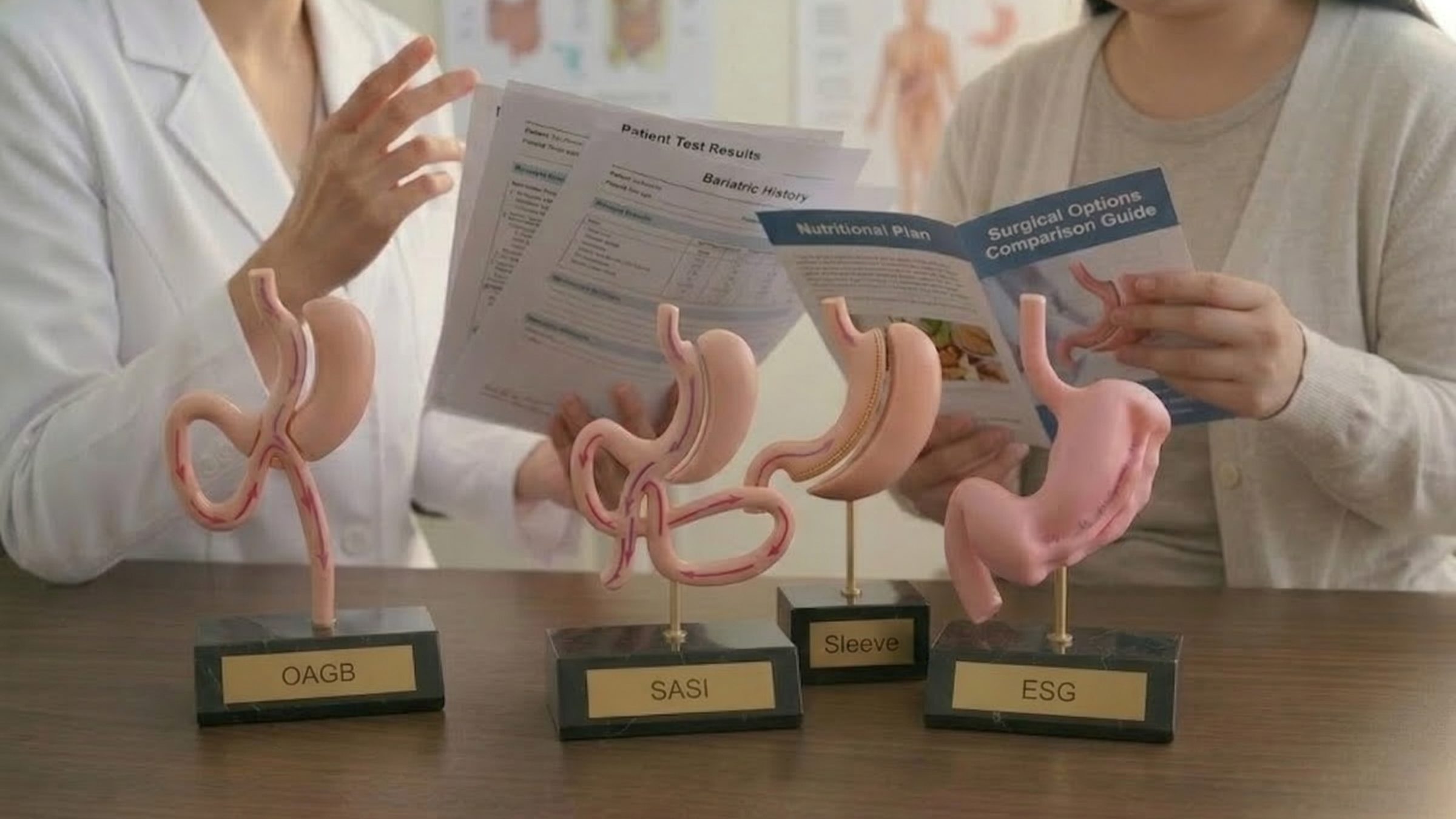
Bariatric Surgery Guide

代謝手術全攻略

探索胃腸道的重塑藝術:主要代謝手術原理解析

為什麼要改變胃腸道的構造?

想像人體的胃腸道是一座精密的「能量處理工廠」,或是這座工廠內複雜的「水利系統」。當進貨量遠超過處理能力,或分配機制失靈時,單純的減產(少吃)往往無法修復核心的系統障礙。

代謝手術的本質,並非機械式地縮減胃的體積,而是一場精密的空間重塑藝術。透過「物理結構的改變」,引發身體深層的「代謝質變」。這不僅能達成限制攝食的目標,更能重整體內的荷爾蒙調節訊號,讓大腦與腸道重新對話,找回代謝的平衡。

接下來,我們將從最基礎的空間減法開始,探索外科醫生如何透過不同邏輯重塑你的消化路徑。

代謝手術全攻略 - 探索胃腸道的重塑藝術

找到最適合你的減重方案

減重手術全方位指南 主要術式深度解析

減重手術沒有「最好的」選擇,只有「最適合你的」選擇。
每個人的身體狀況、BMI、共病症與生活型態都不同——
這份衛教希望幫助你先認識各種術式,再與醫師共同做出最適合自己的決定。

認識減重手術的三大分組

Bariatric & Metabolic Surgery Guide

現代減重手術依其作用機制,可分為三大類別。不同類別的術式在侵入程度、對胃部的處置方式、對腸道的影響,以及代謝改善效果上,都有顯著差異。

第一組|縮胃系列

ESG 胃內縫合 / Sleeve 袖狀胃切除

以「縮小胃容量」為核心目標,不改變腸道路徑。兩種術式的侵入程度差異大:內視鏡胃摺疊不切除組織、體表無切口;袖狀切除則切除並移除約 2/3 胃體,需依個人條件審慎選擇。

第二組|繞道系列

RYGB 胃繞道 / OAGB 單吻合口繞道

隔出小胃囊(其餘的胃留在體內,不切除)並改變腸道路徑,同時達到限制攝入與減少吸收的雙重效果,對代謝疾病(尤其是第二型糖尿病)的改善效果顯著。

第三組|雙通道複合術

SASI / SASJ

結合袖狀胃切除(縮胃)與腸道分流技術,建立獨特的「雙通道」系統。食物可同步經由天然路徑與捷徑分流,在維持進食限制的同時,精準強化遠端腸道荷爾蒙分泌,達成代謝重塑。

點擊左方選單,探索各術式詳細說明。

第一組|縮胃系列

Volume Reduction

核心機制|

縮小胃的容量,減少每餐的食物攝取量以產生飽足感。此系列術式均不改變腸道路徑。

臨床特點|

兩種術式的侵入程度差異大:內視鏡胃摺疊經口進行、不切除組織;袖狀切除以腹腔鏡切除並移除約三分之二胃體,需依個人條件審慎評估。

侵入較低
內視鏡胃摺疊(ESG)

微創內視鏡手術,內部縫合將胃腔縮小,不切除組織,體表無切口。適合希望縮胃但不願切除臟器者。

侵入中等
胃袖狀切除(SG)

永久切除並移除約三分之二的胃體,不可逆術式。不改變腸道路徑,已有長達 10 年的隨機試驗追蹤資料。

第二組|繞道系列

Bypass & Metabolic Rerouting

核心機制|

將胃隔出一個小胃囊並改變腸道路徑,達到限制攝入與減少吸收的雙重效果。其餘的胃留在體內,但不再有食物通過。

臨床特點|

對於合併代謝症候群(如第二型糖尿病、高血脂)的患者,繞道手術具有更顯著且長效的代謝改善與控糖效果。

侵入高
胃繞道(RYGB)

雙吻合口設計,黃金標準術式,糖尿病緩解率高。同時具備極佳的胃食道逆流改善效果。

侵入中高
迷你胃繞道(OAGB)

單一吻合口設計,手術時間較短,代謝效果與減重強度相當。但解剖構造上有膽汁逆流的潛在風險。

第三組|雙通道複合術

Dual-Path Surgery

核心機制|

結合袖狀胃切除(縮胃)與腸道分流技術,建立獨特的「雙通道」系統。食物可同步經由天然路徑與捷徑分流。

臨床特點|

兼具縮胃術的結構安全性與繞道術式的代謝效益,保留部分正常消化路徑,可依據需求調整接合位置(迴腸或空腸)。

接合迴腸
單吻合迴腸雙通道繞道 (SASI)

切除 2/3 胃體並接合遠端迴腸,強力啟動腸泌素,屬於追求強效控糖與減重的新一代術式。

接合空腸
單吻合空腸雙通道繞道 (SASJ)

切除 2/3 胃體並接合近端空腸,舒緩胃部壓力改善逆流,屬於兼顧生理安全與生活品質的複合術式。

內視鏡胃摺疊術

Endoscopic Sleeve Gastroplasty(ESG)

侵入程度:低|微創內視鏡手術

利用特殊內視鏡縫合器,從口腔進入、不開刀,在胃壁內部進行多點縫合,將胃腔如抽繩般縮小約 70%,原理類似袖狀切除,但保留了所有的胃組織。

  • ›輕中度肥胖,希望縮胃效果但不願接受切除臟器者
  • ›對手術風險較敏感、希望體表完全無疤痕者
  • ✓無體表切口,恢復極快
  • ✓不切除胃組織,保有較高安全性
  • !若長期暴飲暴食,內部縫線可能有鬆脫風險導致復胖
  • !減重效果通常略遜於直接切除的 SG 手術

胃袖狀切除手術

Sleeve Gastrectomy(SG)

侵入程度:中|腹腔鏡手術

以腹腔鏡切除並「移除」胃的大彎側(約 2/3 胃體),使胃形成一細長的管狀(袖狀)。此舉除了縮減容量,更移除了分泌飢餓荷爾蒙(Ghrelin)的主要區域,從根源降低食慾。

  • ›符合健保或亞太減重手術標準的病態性肥胖患者
  • ›希望追求長期穩定減重效果的主流首選
  • ✓不改變腸道結構,消化路徑最自然,極少嚴重營養不良
  • ✓有效降低飢餓荷爾蒙,大幅減輕術後對食物的渴望
  • !胃組織遭切除後「不可逆」
  • !術後胃管內壓力增加,部分患者可能誘發或加重胃食道逆流 (GERD)

Roux-en-Y 胃繞道

Roux-en-Y Gastric Bypass(RYGB)

侵入程度:高|腹腔鏡手術

將胃部上方隔離成約 30cc 的微小胃囊(不移除剩下的大胃袋),並將小腸重新接合(雙吻合口設計),讓食物跳過十二指腸與前段空腸。結合了「限制食量」與「吸收不良」,並強烈改變腸泌素(如 GLP-1)的分泌以逆轉胰島素阻抗。

  • ›合併嚴重第二型糖尿病之肥胖患者(黃金標準)
  • ›患有嚴重胃食道逆流(GERD)的減重患者
  • ✓對糖尿病與代謝症候群的長期緩解率高
  • ✓有效治療胃食道逆流,是此類患者的首選
  • !解剖改變大,大胃袋被隔離後無法再使用一般胃鏡檢查
  • !易產生傾倒症候群,且終身需嚴格補充維他命與微量元素(鐵、鈣等)

單接口/迷你胃繞道

One Anastomosis Gastric Bypass(OAGB)

侵入程度:中高|腹腔鏡手術

將胃部重塑成長管狀的胃囊,並直接與距韌帶 150-200 公分處的小腸進行「單一」的吻合接合。此設計簡化了傳統 RYGB 的雙吻合口,同時達到繞道與減重的效果。

  • ›嚴重肥胖且合併第二型糖尿病的患者
  • ›醫師評估後認為單接口對該患者解剖上更安全者
  • ✓只有一個腸胃吻合口,手術時間較短、減少內疝氣機率
  • ✓減重及糖尿病緩解的強度不亞於甚至略優於傳統 RYGB
  • !解剖構造導致膽汁有逆流回胃部的潛在風險
  • !吸收不良的風險可能略高於 RYGB,同樣需要終生補充營養品

單吻合迴腸雙通道胃繞道

Single Anastomosis Sleeve Ileal Bypass (SASI)

侵入程度:中高|腹腔鏡手術

結合袖狀胃切除與「遠端迴腸」接合。食物進入胃後會分流,一部分走原路徑,另一部分經捷徑直達迴腸。由於迴腸是分泌腸泌素(GLP-1)的大本營,此術式能最大化代謝調節力。

  • ›重度代謝需求:BMI 較高或合併嚴重第二型糖尿病患者。
  • ›追求強效減重:希望透過強大的荷爾蒙調控達成體重長期穩定者。
  • ✓強效控糖:引發極強的 GLP-1 腸泌素分泌,對血糖不穩的患者效果顯著。
  • ✓代謝力強:繞道距離較長,減少吸收的同時也大幅改變食慾與代謝體質。
  • !營養追蹤需嚴謹:因影響吸收程度較大,術後需嚴格補充維生素與蛋白質,預防貧血。
  • !腸道頻率改變:部分患者在術後初期可能出現排便次數增加的情況。

單吻合空腸雙通道胃繞道

Single Anastomosis Sleeve Jejunal Bypass (SASJ)

侵入程度:中高|腹腔鏡手術

結合袖狀胃切除與「近端空腸」接合。食物分流的路徑較短,捷徑連接至空腸。這不僅能啟動初步的代謝調節,更能有效降低胃部壓力,提供更符合生理機能的消化模式。

  • ›輕中度代謝需求:糖尿病症狀尚輕、或單純肥胖合併高血壓之患者。
  • ›逆流困擾者:患有胃食道逆流,或擔心縮胃術後引發胃壓過高者。
  • ✓營養負擔輕:營養影響輕微,仍需定期追蹤維生素 D 等營養素。
  • ✓緩解逆流壓力:多出的「空腸出口」能像洩壓閥一樣舒緩胃部壓力,顯著改善術後酸水逆流。
  • !術式新穎:需確保醫師在空腸吻合技術上有豐富經驗,以維持長期的消化順暢。

術式比較總覽

以下數據為一般參考範圍,實際效果因個人狀況而異

比較項目 ESG
內視鏡胃摺疊
SG
胃袖狀切除
RYGB
胃繞道
OAGB
迷你胃繞道
SASI
雙通道・迴腸
SASJ
雙通道・空腸
侵入程度 * 低 中 高20 中高20 中高33 中高33
胃部處理方式 縫合縮小 切除移除
約 2/3
隔出小胃囊
其餘留在體內
隔出長管狀胃囊
其餘留在體內
切除移除
約 2/3
切除移除
約 2/3
改變腸道 否 否 是 是 是
保留原路徑
是
保留原路徑
預期 TBWL
(術後 12 個月)
15–20%1,2,3 25–30%9,29 30–35%9 30–35%17,18 30–40%24 30–35%29,31
糖尿病改善效力 † 中4 中36,39 高35,36,38 極高39 極高24,28 高33
胃食道逆流影響 少見5 可能加重13,40 通常改善13,40 需評估
(含膽汁逆流)19
多數改善28 多數改善33,41,42
可逆性 ‡ 部分可逆8 不可逆 可逆43 可逆45 不可逆 不可逆
最長追蹤證據 § 5 年
世代研究6,7
10 年
隨機試驗13,14
10 年隨機試驗
15 年世代研究13,14,15,16
7 年隨機試驗
15 年回溯研究21,22,23
10 年
單中心27
6 年
單中心32

表格中的上標數字為下方參考文獻的編號,點選可直接對照出處。

* 侵入程度為術式間的相對比較,分級依據為處置途徑(內視鏡或腹腔鏡)、吻合口數量與手術時間。

† 糖尿病改善效力分級係基於現有文獻之術式間相對比較,並非絕對門檻。各術式之第二型糖尿病緩解率受患者年齡、糖尿病病程、術前 HbA1c、BMI 及用藥狀況等多重因素影響,實際成效因人而異。

‡ 可逆性以物理上能否恢復原本構造判斷,有切除胃組織即為不可逆。「可逆」不代表還原手術常見:還原手術多用於處理嚴重併發症,實際上極少施行(瑞典全國 RYGB 還原率約 0.3%,參考文獻 43),且還原後體重通常回升(參考文獻 44)。

§ 列出本會查得各術式追蹤時間最長的已發表研究與其研究類型(截至 2026 年 9 月)。隨機試驗的證據強度高於世代研究、回溯研究與單中心研究,讀者可依年數與研究類型自行判斷資料成熟度。

TBWL = Total Body Weight Loss(總體重減少百分比),為減重手術成效之國際通用指標。本列以術後約 12 個月之數據為主要參考範圍,來源為各術式之系統性回顧、統合分析、國際學會立場文件與大型世代研究。減重幅度通常於術後 12–18 個月達高峰。

本表數據主要來自歐美與中東地區的研究。亞洲族群的起始 BMI 較低,2022 年 ASMBS/IFSO 適應症指引即建議亞洲人的 BMI 門檻應下調(BMI 超過 25 即屬臨床肥胖,超過 27.5 即可考慮手術,參考文獻 46),因此同一術式換算成總體重減少百分比,可能與國際文獻的數字有差距。台灣本土資料請見參考文獻 29(台灣五中心研究)。

參考文獻

  1. ESG 內視鏡胃摺疊
  2. Abu Dayyeh BK, et al.(IFSO 減重內視鏡委員會)IFSO Bariatric Endoscopy Committee Evidence-Based Review and Position Statement on Endoscopic Sleeve Gastroplasty for Obesity Management. Obesity Surgery. 2024;34(12):4318–4348. PMID 39482444 · DOI
  3. Hedjoudje A, et al. Efficacy and Safety of Endoscopic Sleeve Gastroplasty: A Systematic Review and Meta-Analysis. Clinical Gastroenterology and Hepatology. 2020;18(5):1043–1053.e4. PMID 31442601
  4. Singh S, et al. Intragastric Balloon Versus Endoscopic Sleeve Gastroplasty for the Treatment of Obesity: a Systematic Review and Meta-analysis. Obesity Surgery. 2020;30(8):3010–3029. PMID 32399847 · DOI
  5. Qiu X, Yu S. Endoscopic Sleeve Gastroplasty for Type 2 Diabetes: A Systematic Review and Meta-Analysis Focusing on Diabetes Remission, Glycemic Control and Body Weight Loss. Diabetes, Metabolic Syndrome and Obesity. 2026;19:612932. PMID 42553609 · DOI
  6. Beran A, et al. Comparative Effectiveness and Safety Between Endoscopic Sleeve Gastroplasty and Laparoscopic Sleeve Gastrectomy: a Meta-analysis of 6775 Individuals with Obesity. Obesity Surgery. 2022;32(11):3504–3512. PMID 36053446 · DOI
  7. Sharaiha RZ, et al. Five-Year Outcomes of Endoscopic Sleeve Gastroplasty for the Treatment of Obesity. Clinical Gastroenterology and Hepatology. 2021;19(5):1051–1057.e2. PMID 33011292 · DOI
  8. Barghash M, et al. Short-Term Versus Long-Term Efficacy of Endoscopic Sleeve Gastroplasty in 8880 Obese Patients: A Systematic Review and Meta-Analysis. Diabetes, Obesity and Metabolism. 2026;28(9):8189–8207. PMID 42315493 · DOI
  9. Cheng Q, et al. Reversal of endoscopic sleeve gastroplasty and conversion to sleeve gastrectomy: two case reports. International Journal of Surgery Case Reports. 2020;68:180–184. PMID 32172193 · DOI
  10. SG 胃袖狀切除・RYGB 胃繞道
  11. Ghusn W, et al. Mapping the continuum of procedural bariatric care: real-world weight loss after endoscopic and surgical interventions. Surgical Endoscopy. 2026;40(8):6714–6721. PMID 42277424 · DOI
  12. Lei Y, et al. Update on comparison of laparoscopic sleeve gastrectomy and laparoscopic Roux-en-Y gastric bypass: a systematic review and meta-analysis of weight loss, comorbidities, and quality of life at 5 years. BMC Surgery. 2024;24(1):219. PMID 39080707 · DOI
  13. Monteiro Delgado L, et al. Long-Term Outcomes in Sleeve Gastrectomy versus Roux-en-Y Gastric Bypass: a systematic review and meta-analysis of randomized trials. Obesity Surgery. 2025;35(8):3246–3257. PMID 40622470 · DOI
  14. Sharples AJ, Mahawar K. Systematic Review and Meta-Analysis of Randomised Controlled Trials Comparing Long-Term Outcomes of Roux-En-Y Gastric Bypass and Sleeve Gastrectomy. Obesity Surgery. 2020;30(2):664–672. PMID 31724116 · DOI
  15. Salminen P, et al. Effect of Laparoscopic Sleeve Gastrectomy vs Roux-en-Y Gastric Bypass on Weight Loss, Comorbidities, and Reflux at 10 Years in Adult Patients With Obesity: The SLEEVEPASS Randomized Clinical Trial. JAMA Surgery. 2022;157(8):656–666. PMID 35731535 · DOI
  16. Kraljevic M, et al. Long-Term Outcomes of Laparoscopic Roux-en-Y Gastric Bypass vs Laparoscopic Sleeve Gastrectomy for Obesity: The SM-BOSS Randomized Clinical Trial. JAMA Surgery. 2025;160(4):369–377. PMID 39969869 · DOI
  17. Adams TD, et al. Weight and Metabolic Outcomes 12 Years after Gastric Bypass. The New England Journal of Medicine. 2017;377(12):1143–1155. PMID 28930514 · DOI
  18. Jawhar N, et al. Comprehensive outcomes after Roux-en-Y gastric bypass with a near-complete 15-year follow-up. Surgery. 2024;176(3):586–594. PMID 38769035 · DOI
  19. OAGB 迷你胃繞道
  20. Mitra A, et al. Long-Term Outcomes of One Anastomosis Gastric Bypass: A Systematic Review and Meta-Analysis of 5-Year and Beyond. Obesity Surgery. 2026;36(1):71–87. PMID 41094294 · DOI
  21. Currie AC, et al. National introduction of one-anastomosis gastric bypass in the UK National Bariatric Surgery Registry: a cohort study. International Journal of Surgery. 2024;110(12):7404–7413. PMID 39311895 · DOI
  22. Ortíz-Gómez JE, et al. One anastomosis gastric bypass (OAGB): a scoping review. BMC Surgery. 2025;25(1):471. PMID 41074037 · DOI
  23. Li X, et al. Efficacy and Safety of One Anastomosis Gastric Bypass Versus Roux-en-Y Gastric Bypass for Obesity: a Meta-analysis and Systematic Review. Obesity Surgery. 2023;33(2):611–622. PMID 36564618 · DOI
  24. Jain M, et al. LSG vs OAGB: 7-Year Follow-up Data of a Randomised Control Trial and Comparative Outcome Based on BAROS Score. Obesity Surgery. 2024;34(4):1295–1305. PMID 38427149 · DOI
  25. Azizi S, et al. Efficacy and safety of one anastomosis gastric bypass in long-term follow-up: a meta-analysis of studies with at least 10 years of follow-up. Journal of Gastrointestinal Surgery. 2026;30(10):102536. PMID 42508723 · DOI
  26. Abu-Abeid A, et al. Long-Term Outcomes of One-Anastomosis Gastric Bypass: A Systematic Review of Studies with at Least 10 Years of Follow-Up. Obesity Surgery. 2026;36(2):887–893. PMID 41491275 · DOI
  27. SASI 雙通道・迴腸
  28. Ataya K, et al. Outcomes of Single Anastomosis Sleeve Ileal (SASI) Bypass as an Alternative Procedure in Treating Obesity: An Updated Systematic Review and Meta-Analysis. Obesity Surgery. 2024;34(9):3285–3297. PMID 39060638 · DOI
  29. Rodrigues de Oliveira Filho J, et al. Single anastomosis sleeve ileal (SASI) bypass outcomes and complications: single-arm meta-analysis. Surgical Endoscopy. 2026;40(2):1536–1548. PMID 41326728 · DOI
  30. Aghajani E, et al. Mid-term outcomes after single anastomosis sleeve ileal (SASI) bypass in treatment of morbid obesity. Surgical Endoscopy. 2023;37(8):6220–6227. PMID 37171643 · DOI
  31. Hamed H, et al. Ten-year outcomes of single-anastomosis sleeve ileal (SASI) bypass: surgical configuration determines long-term efficacy and safety. Obesity Surgery. 2026;36(3):960–970. PMID 41606353 · DOI
  32. Rodrigues de Oliveira Filho J, et al. GERD remission and safety profile of Single Anastomosis Sleeve Ileal (SASI) bypass vs sleeve gastrectomy (SG): a systematic review and meta-analysis. Surgical Endoscopy. 2026;40(4):3461–3474. PMID 42377474 · DOI
  33. SASJ 雙通道・空腸
  34. Lin YH, Ser KH, et al. Two-year outcomes of single anastomosis sleeve jejunal bypass (SASJ) vs sleeve gastrectomy: a Taiwanese multi-center study. International Journal of Surgery. 2026. PMID 41677340 · DOI
  35. Moeinvaziri N, et al. One-year Weight Loss and Metabolic Outcomes of Single Anastomosis Sleeve Jejunal Bypass: A Retrospective Report with Reference to Roux-en-Y Gastric Bypass. Obesity Surgery. 2026;36(2):573–583. PMID 41396245 · DOI
  36. Moeinvaziri N, et al. Comparison of 12-Month Outcome of Single Anastomosis Sleeve Jejunal Bypass Compared to Roux-en-Y Gastric Bypass and Sleeve Gastrectomy: A Propensity Score Matching Analysis. Obesity Surgery. 2026;36(9):4697–4706. PMID 42481892 · DOI
  37. Sewefy AM, et al. Single anastomosis sleeve jejunal (SAS-J) bypass as a treatment for morbid obesity, technique and review of 1986 cases and 6 years follow-up. Retrospective cohort. International Journal of Surgery. 2022;102:106662. PMID 35568310 · DOI
  38. Jin CC, et al. Efficacy and safety of single-anastomosis gastric bypass variants versus sleeve gastrectomy or Roux-en-Y gastric bypass: a systematic review and meta-analysis. Updates in Surgery. 2026;78(2):893–907. PMID 41606202 · DOI
  39. 第二型糖尿病緩解
  40. Balasubaramaniam V, Pouwels S. Remission of Type 2 Diabetes Mellitus (T2DM) after Sleeve Gastrectomy (SG), One-Anastomosis Gastric Bypass (OAGB), and Roux-en-Y Gastric Bypass (RYGB): A Systematic Review. Medicina (Kaunas). 2023;59(5):985. PMID 37241216 · DOI
  41. Moradi M, et al. Type 2 diabetes remission after Roux-en-Y gastric bypass (RYGB), sleeve gastrectomy (SG), and one anastomosis gastric bypass (OAGB): results of the longitudinal assessment of bariatric surgery study. BMC Endocrine Disorders. 2022;22(1):260. PMID 36289529
  42. Currie AC, et al. Network Meta-Analysis of Metabolic Surgery Procedures for the Treatment of Obesity and Diabetes. Obesity Surgery. 2021;31(10):4528–4541. PMID 34363144 · DOI
  43. Uhe I, et al. Roux-en-Y gastric bypass, sleeve gastrectomy, or one-anastomosis gastric bypass? A systematic review and meta-analysis of randomized-controlled trials. Obesity (Silver Spring). 2022;30(3):614–627. PMID 35137548 · DOI
  44. Singh B, et al. One Anastomosis Gastric Bypass (OAGB) vs Roux en Y Gastric Bypass (RYGB) for Remission of T2DM in Patients with Morbid Obesity: a Randomized Controlled Trial. Obesity Surgery. 2023;33(4):1218–1227. PMID 36807043 · DOI
  45. Shen SC, Lee WJ, et al. Efficacy of Different Procedures of Metabolic Surgery for Type 2 Diabetes in Asia: a Multinational and Multicenter Exploratory Study. Obesity Surgery. 2021;31(5):2153–2160. PMID 33523416 · DOI
  46. 胃食道逆流
  47. Memon MA, et al. The effect of laparoscopic vertical sleeve gastrectomy and laparoscopic Roux-en-Y gastric bypass on gastroesophageal reflux disease: an updated meta-analysis and systematic review of 5-year post-operative data from randomized controlled trials. Surgical Endoscopy. 2024;38(11):6254–6269. PMID 39384655 · DOI
  48. Noel P, et al. Gastroesophageal Reflux Disease Outcomes after Sleeve Gastrectomy with One Anastomosis Transit Bipartition: A Systematic Review and Meta-analysis. Obesity Surgery. 2026;36(4):1965–1974. PMID 41863564 · DOI
  49. Wang J, et al. Incidence of de novo gastroesophageal reflux disease following sleeve gastrectomy versus sleeve gastrectomy with transit bipartition: a retrospective cohort study. Surgical Endoscopy. 2026;40(1):118–125. PMID 41042344 · DOI
  50. 可逆性與還原手術
  51. Sillén L, et al. Reversal of Roux-en-Y Gastric Bypass: A Swedish National Cohort Study. Annals of Surgery. 2026. PMID 42041235 · DOI
  52. Wafa A, et al. Anatomic Reversal of Gastric Bypass as a Last Resort for Refractory Complications: A Retrospective Case Series. Obesity Surgery. 2026;36(9):4732–4741. PMID 42477224 · DOI
  53. Kermansaravi M, et al. Reversal to normal anatomy after one-anastomosis/mini gastric bypass, indications and results: a systematic review and meta-analysis. Surgery for Obesity and Related Diseases. 2021;17(8):1489–1496. PMID 34045165 · DOI
  54. 適應症與族群
  55. Eisenberg D, et al. 2022 American Society of Metabolic and Bariatric Surgery (ASMBS) and International Federation for the Surgery of Obesity and Metabolic Disorders (IFSO) Indications for Metabolic and Bariatric Surgery. Obesity Surgery. 2023;33(1):3–14. PMID 36336720 · DOI

本表減重成效數據的原始依據,為 IFSO、ASMBS 等國際醫學會指引與大型臨床試驗之彙整;其中內視鏡胃摺疊可直接對應學會層級的立場文件(見上方「ESG 內視鏡胃摺疊」一組)。其餘術式的文獻多以 %EWL 或術式間差值呈現,單一術式 12 個月的絕對 %TWL 證據有限,故並列大型世代與登錄研究,各篇文獻標題已載明其研究設計。

與醫師一起做決定

減重手術的選擇沒有標準答案。
每一種術式都有其適合的族群,沒有哪一種手術對所有人都是最好的選擇。

影響術式選擇的關鍵因素
  • ›目前的 BMI 與共病症狀況
  • ›是否已有胃食道逆流
  • ›對手術風險的接受程度
  • ›術後生活型態的配合意願
  • ›醫師對你整體狀況的臨床判斷
我們建議你這樣做
  • ›謹慎選擇合格院所與專科醫師深入討論
  • ›誠實告知所有病史與用藥狀況
  • ›充分理解術後的生活調整需求
  • ›不急於決定,充分思考後再行動
  • ›術後長期追蹤,讓效果持續發揮